


About Vijay Diwas
Vijay Diwas, observed annually on 16 December in India, commemorates the decisive victory of the Indian Armed Forces over Pakistan in the Indo-Pakistani War of 1971. This day marks the formal surrender of Pakistani forces in East Pakistan (now Bangladesh), leading to the liberation and independence of Bangladesh. It honors the bravery, sacrifice, and strategic prowess of Indian soldiers, sailors, and airmen who participated in one of the shortest yet most impactful wars in modern history.
Introduction
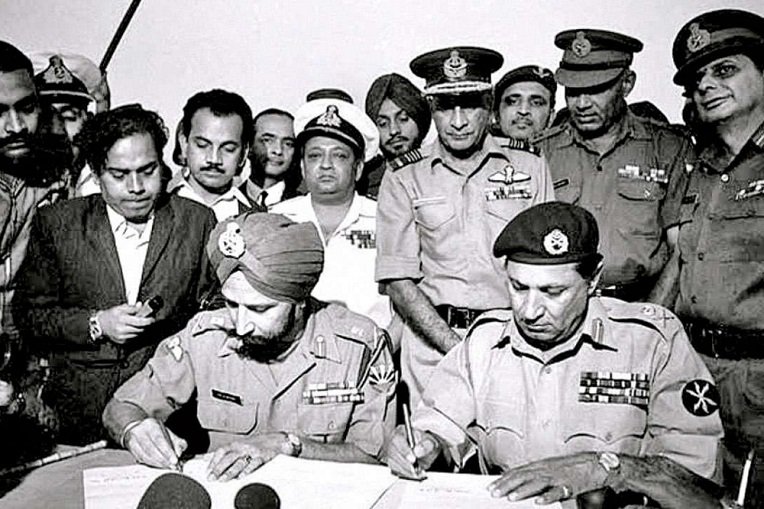
Definition: Vijay Diwas (Victory Day) specifically refers to the culmination of the 1971 war on 16 December, when Lieutenant General A. A. K. Niazi of the Pakistan Army signed the Instrument of Surrender in Dhaka, handing over control to Indian and Bangladeshi forces.
Commemoration: The day is dedicated to remembering the approximately 3,900 Indian soldiers who lost their lives and the over 9,000 who were wounded. It also celebrates the role of the Mukti Bahini (Bangladesh liberation fighters) and India’s support in ending the atrocities committed during the Bangladesh Liberation War.
Global Context: In Bangladesh, the same day is observed as Bijoy Dibosh (Victory Day), marking their independence from Pakistan.
History
The 1971 Indo-Pakistani War, lasting just 13 days, was a direct result of the political and humanitarian crisis in East Pakistan. It is often described as a “just war” due to India’s intervention to halt genocide and support self-determination.
Background
Political Tensions in Pakistan: Post-Partition in 1947, Pakistan was divided into West Pakistan (modern-day Pakistan) and East Pakistan (modern-day Bangladesh), separated by over 1,600 km of Indian territory. Linguistic, cultural, and economic disparities fueled resentment in the East, where Bengalis felt marginalized by the Urdu-speaking West Pakistani elite.
1970 Elections: The Awami League, led by Sheikh Mujibur Rahman, won a landslide victory in the 1970 general elections, securing 167 out of 169 seats in East Pakistan and an overall majority. However, West Pakistani leaders, including President Yahya Khan and Zulfikar Ali Bhutto, refused to transfer power, leading to widespread protests.
Refugee Crisis: The ensuing crackdown displaced 8-10 million Bengalis, mostly Hindus, who sought refuge in India, straining resources and prompting India to support the Mukti Bahini guerrillas.
Causes of the War
Operation Searchlight: On 25 March 1971, the Pakistani military launched a brutal operation to crush Bengali nationalism, resulting in mass killings, rapes, and arson. Estimates of civilian deaths range from 300,000 to 3 million, with 200,000-400,000 women raped. This is widely recognized as genocide.
India’s Involvement: Prime Minister Indira Gandhi condemned the atrocities and provided covert support to the Mukti Bahini. Border skirmishes escalated, with India conducting pre-emptive operations like the Battle of Garibpur in November 1971.
International Factors: The war occurred amid Cold War tensions; India signed a treaty with the Soviet Union for support, while the U.S. (under Nixon and Kissinger) backed Pakistan, even deploying the USS Enterprise to the Bay of Bengal as a show of force.
Key Events and Battles
Pre-War Clashes: Battles such as Dhalai (28 October), Garibpur (20 November), and Hilli (22 November-December) weakened Pakistani positions in the East.
War Declaration: On 3 December 1971, Pakistan launched Operation Chengiz Khan, pre-emptive air strikes on Indian airfields. India responded with a full invasion of East Pakistan.
Eastern Front: Indian forces, under Lt Gen Jagjit Singh Aurora, advanced rapidly. Key operations included the Meghna Heli Bridge (9 December), Tangail Airdrop (11 December), and the encirclement of Dhaka. The Mukti Bahini (180,000 strong) provided crucial intelligence and sabotage.
Western Front: Battles like Longewala (4-7 December), Basantar (4-16 December), and Chhamb (3-11 December) saw India capture strategic territories, including 883 km² in Jammu and Kashmir.
Naval and Air Operations: The Indian Navy sank PNS Ghazi (Pakistan’s submarine) and blockaded East Pakistan. Air battles resulted in Pakistan losing 75 aircraft to India’s 45-65.
Military Strategies
India’s Approach: A blitzkrieg-style offensive with coordinated army, navy, and air force operations. Emphasis on speed to isolate Dhaka before international intervention.
Pakistan’s Strategy: Defensive in the East, with attempts at counter-attacks in the West. Logistical failures and low morale contributed to defeat.
Major Figures
Indian Side: Prime Minister Indira Gandhi (political leadership); Field Marshal Sam Manekshaw (Chief of Army Staff); Lt Gen Jagjit Singh Aurora (Eastern Command); Lt Gen Sagat Singh (IV Corps); Vice Adm N. Krishnan (Eastern Naval Command).
Pakistani Side: President Yahya Khan; Lt Gen A.A.K. Niazi (Eastern Command); Lt Gen Tikka Khan (Governor of East Pakistan).
Bangladeshi Side: Sheikh Mujibur Rahman (Awami League leader); Gen M.A.G. Osmani (Mukti Bahini commander).
Timeline
25 March 1971: Operation Searchlight begins in East Pakistan.
26 March 1971: Sheikh Mujibur Rahman declares Bangladesh’s independence.
October-November 1971: Border battles and Indian incursions.
3 December 1971: Pakistan attacks Indian airfields; India declares war.
4-15 December 1971: Rapid Indian advances in East Pakistan.
16 December 1971: Surrender in Dhaka at 16:31 IST.
17 December 1971: Ceasefire on the Western Front.
Surrender and Creation of Bangladesh
The Surrender Ceremony: At Ramna Race Course in Dhaka, Lt Gen Niazi signed the surrender document before Lt Gen Aurora, surrendering 93,000 troops (including 79,676-81,000 military personnel and civilians). This was the largest surrender since World War II.
Birth of Bangladesh: East Pakistan officially became the independent nation of Bangladesh, with Sheikh Mujibur Rahman as its first leader. India recognized it immediately, followed by others.
POWs and Repatriation: India held 90,368-93,000 Pakistani POWs, who were repatriated under the Simla Agreement in 1972-1974.
Significance for India
Military Triumph: The war established India as a regional superpower, with Pakistan losing half its population, a significant portion of its economy, and military strength (one-third of its army, half its navy, one-quarter of its air force).
Humanitarian Impact: India’s intervention halted the genocide and facilitated the return of 10 million refugees, showcasing its commitment to human rights.
Strategic Gains: India captured and retained key territories, shifting the balance of power in South Asia and influencing future Indo-Pak relations.
National Pride: It boosted morale and led to awards like the Param Vir Chakra for heroes such as Lance Naik Albert Ekka and Flying Officer Nirmal Jit Singh Sekhon.
Long-Term Importance: The victory inspired India’s nuclear program and highlighted the need for strong defense, while exposing ethnic vulnerabilities in multi-ethnic states.
Celebrations and Observances
In India: Annual events include parades, wreath-laying at war memorials (e.g., National War Memorial in Delhi), and tributes to veterans. Schools and media feature stories of heroism. In 2021, the 50th anniversary (Swarnim Vijay Varsh) included nationwide events.
In Bangladesh: Parades in Dhaka, honors to Mukti Bahini martyrs, and awards to Indian allies (e.g., Indira Gandhi received the Bangladesh Freedom Honour posthumously in 2011).
Memorials: Key sites include the Martyred Intellectuals Memorial in Bangladesh and battlefields like Longewala in India, preserved as museums.
Post-War Impacts and Legacy
Human Cost: India: 2,500-3,843 killed, 9,851-12,000 wounded. Pakistan: 5,866-9,000 killed, 10,000-25,000 wounded. Mukti Bahini: 30,000 killed. Civilian deaths in East Pakistan: 300,000-3 million.
Treaties: The Simla Agreement (2 July 1972) between Indira Gandhi and Zulfikar Ali Bhutto established the Line of Control in Kashmir and committed to bilateral resolutions.
Legacy: The war led to Pakistan’s Hamoodur Rahman Commission, which criticized military leadership for atrocities but resulted in no trials. It accelerated Pakistan’s nuclear ambitions and reshaped South Asian geopolitics.
Related Facts, Statistics, and Controversies
Statistics: Indian forces: 825,000-860,000 troops; Pakistani: 350,000-365,000. Air losses: India 45-65; Pakistan 75. Naval losses: Pakistan lost 2 destroyers, 1 submarine; India 1 frigate.
Controversies: Pakistan denies the scale of the genocide, with estimates varying widely. The U.S. “tilt” toward Pakistan drew criticism. Bangladesh’s 2010 International Crimes Tribunal prosecuted collaborators, leading to executions and diplomatic tensions.
Cultural Impact: The war inspired films, books, and songs in India and Bangladesh, such as the Bollywood movie Border (based on Longewala) and Bangladeshi literature on the liberation.


